The Math Behind Craps: Calculating Edges on Every Bet
Uma Hartmann · Apr 15, 2026
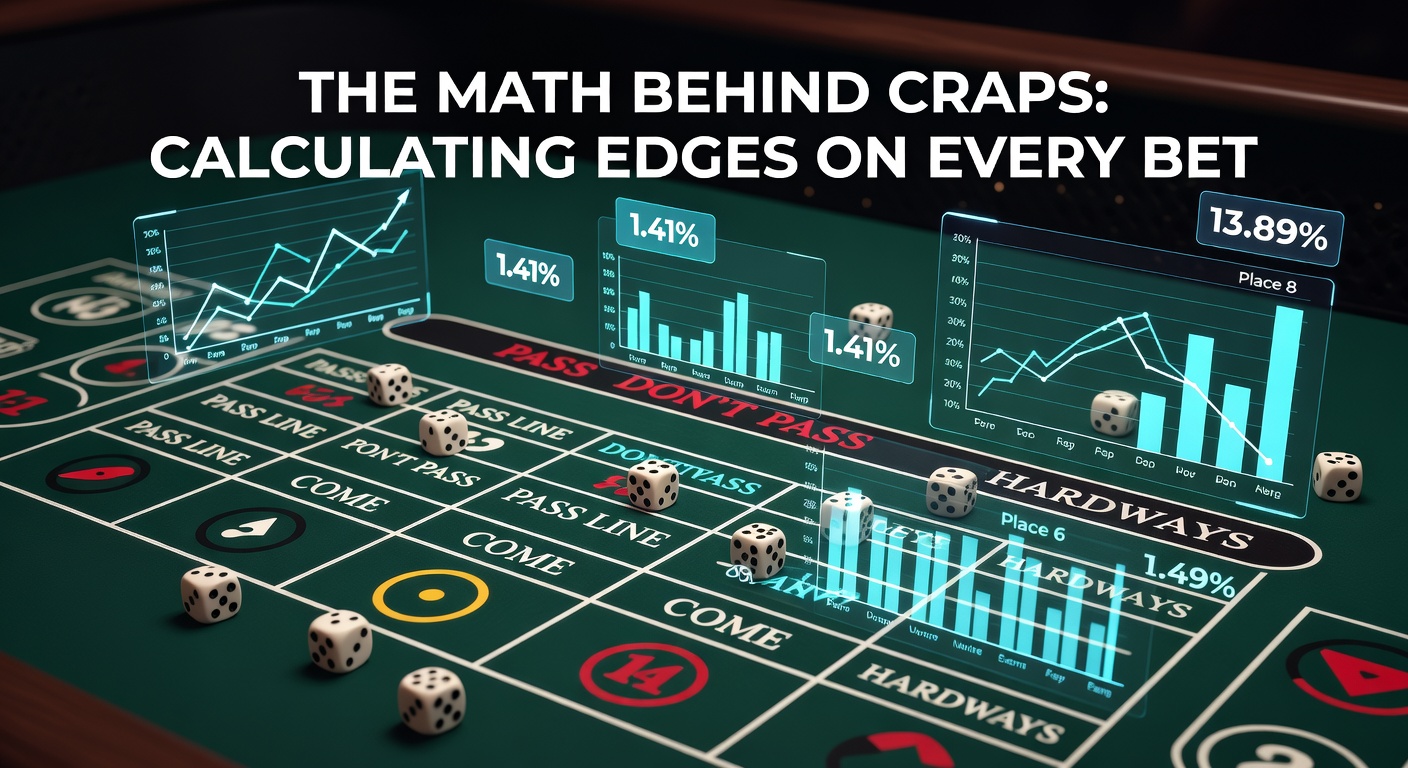
The Math Behind Craps: Calculating Edges on Every Bet
Craps Fundamentals and the Role of Probability
Craps draws crowds in casinos worldwide because of its fast pace and social energy, yet beneath the excitement lies a precise mathematical framework that determines every outcome; two dice, each with six faces, produce 36 possible combinations on every roll, and understanding these probabilities reveals the house edge on each bet. Players establish points on come-out rolls—numbers like 4, 5, 6, 8, 9, or 10—and then aim to hit them before a 7, while pass line bets win on 7 or 11 right away, and don't pass bets take the opposite stance. Data from the Nevada Gaming Control Board shows craps generating over $1 billion in annual revenue in Nevada alone as of early 2026, with April figures highlighting a surge tied to post-pandemic tourism; this popularity underscores why calculating edges matters, as the house always holds a mathematical advantage except on certain free-odds wagers.
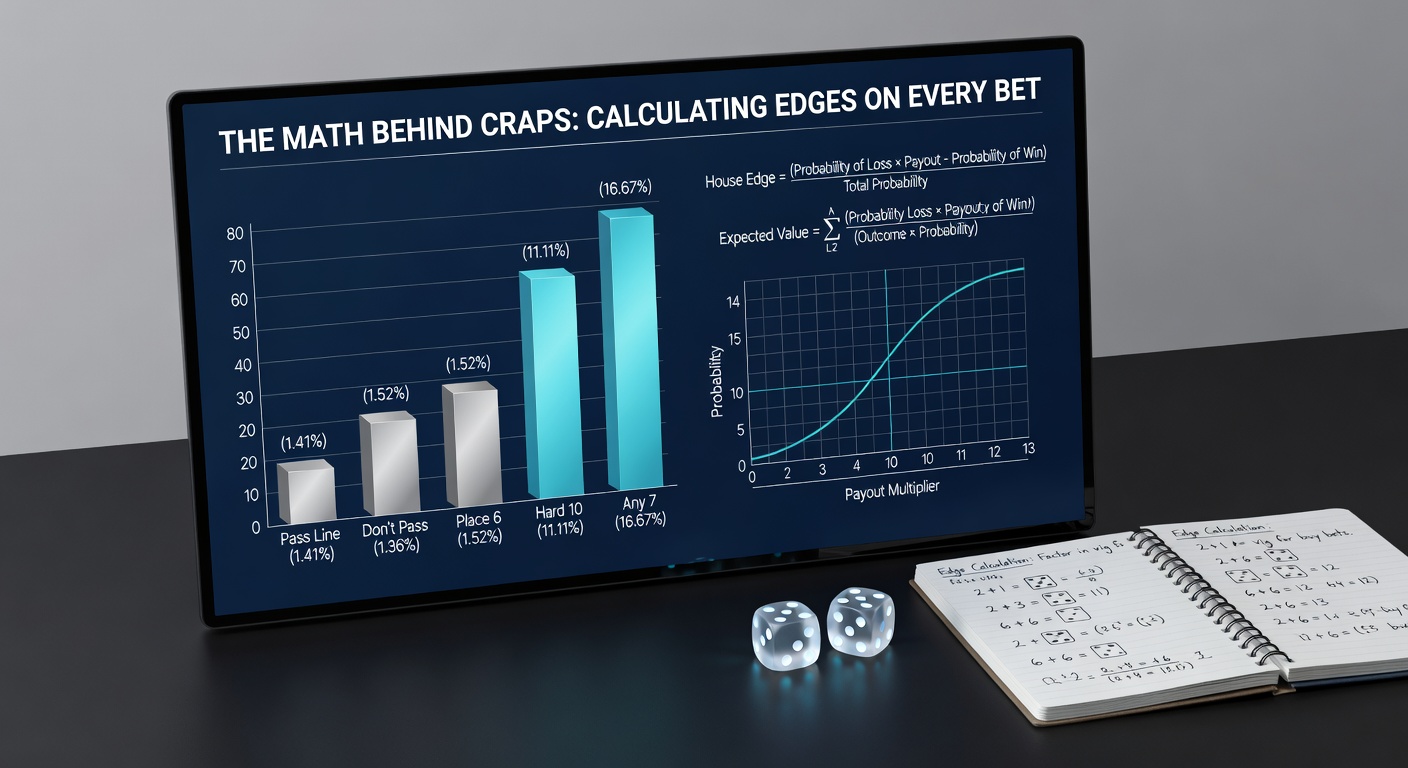
House edge represents the casino's average profit per bet resolved, expressed as a percentage of the wager; for instance, a 1.41% edge means the house keeps $1.41 for every $100 bet over millions of rolls. Experts break it down using true odds—the actual probability ratios—versus payout odds offered, and the difference creates that edge. But here's the thing: while basic bets hover around 1-2%, proposition wagers spike to 16% or more, turning casual rolls into costly traps.
Pass Line and Don't Pass: The Core Wagers
Pass line bets form the backbone of craps tables, winning immediately on come-out rolls of 7 or 11, losing on 2, 3, or 12 (known as craps), and setting a point otherwise; once established, the shooter must roll that point before 7 to pay even money. Calculations reveal 244 ways to win out of 1,080 total point-resolution scenarios across all points, yielding a house edge of 1.41%, while don't pass flips it—winning on 2 or 3, pushing on 12, losing on 7/11 come-out, and requiring 7 before the point—with a slightly better 1.36% edge because of that 12 push. Studies from gaming mathematicians, including those compiled by independent analysts, confirm these figures hold across billions of simulated rolls.
What's interesting is how odds bets attach here; after a point, players back pass or don't pass with free odds at true probabilities—say, 2-to-1 on a 4 or 10, 3-to-2 on 5 or 9, 6-to-5 on 6 or 8—dropping the combined edge to fractions of a percent when taken in full, like 0.02% on pass with 100x odds. Casinos in Las Vegas offered up to 100x odds by April 2026, per industry reports, making this the sharpest play on the felt.
Come and Don't Come Bets Mirror the Foundation
Come bets act like pass line wagers placed after the come-out, establishing their own points on the next roll (except 7/11 win or craps loss), and resolving identically; their house edge matches pass line at 1.41%, while don't come bets echo don't pass at 1.36%, allowing multiple points to work simultaneously. Players often find layering these creates action, but math shows the edges compound independently on each, so a table full of come bets still faces the same underlying probabilities—36 outcomes per roll, with 7 always the showstopper at 6/36 chance.
Attaching odds to come bets works the same way, slashing edges dramatically; for example, one observer noted a session where full double odds on multiple come bets reduced effective exposure to under 0.6%, turning volatile rolls into steady grinds. Turns out, this mirroring keeps strategies consistent across phases.
Place Bets: Targeting Specific Points
Place bets wager on 4, 5, 6, 8, 9, or 10 hitting before 7, with payouts at 9-to-5 for 4/10, 7-to-5 for 5/9, and 7-to-6 for 6/8; yet true odds differ—3-to-2 for 4/10 wait no, actually 2-to-1 true for 4/10 but paid less—leading to edges of 6.67% on 4/10, 4% on 5/9, and 1.52% on 6/8. Researchers compute this via ways-to-hit versus ways-to-seven: six ways for 6/8 out of 36, five for 5/9, three for 4/10, but against 7's six ways, so place 6/8 shines relatively. Casinos "turn off" these during come-out to avoid confusion, but math stays fixed.
Buy bets improve this by paying true odds minus a 5% vig, profitable on 4/10 where 2-to-1 true exceeds 9-to-5 place; data indicates edges drop to 1.67% after vig on $20+ buys, yet most skip because vig hits upfront. Lay bets reverse for don't-pass fans, laying to win on 7 before point, again with vig-adjusted true odds.
Field Bet and Proposition Wagers: High-Edge Traps
Field bets cover 2, 3, 4, 9, 10, 11, 12 on the next roll, paying even money on 3/4/9/10/11 (16/36 ways) and double on 2/12 (3/36 total extra); but with 12 sometimes triple, standard edges land at 5.56%, or 2.78% with double on both ends—still worse than pass line. One study from Gaming Laboratories International, which certifies table games globally, verifies these through rigorous simulations matching casino payouts.
Proposition bets sit center-table, pure next-roll gambles: Any 7 at 4-to-1 despite 5-to-1 true (16.67% edge), Hardways like 4 (3-to-1 paid, 9-to-1 true, 11% edge), Horn covering 2/3/11/12 at 2.78% average. These suck in novices with big promised payouts, yet math exposes the slaughter—over 10% edges common, and Yo-11 at 11.11% rounds it out. Experts observe tables where props light up sporadically, but long-term data crushes them relentlessly.
Big 6/8 and Other Side Bets
Big 6 and Big 8 mimic place 6/8 at even money instead of 7-to-6, bumping edge to 9.09%; simple, sure, but costly compared to proper places. C&E (craps and eleven) blends craps (2/3/12) at 7-to-1 with 11 at 3-to-1 false odds, hitting 11.11% edge. And hop bets on specific combos, like 5-2 for 3, pay 15-to-1 on 30-to-1 true shots—16.67% edge territory.
Now consider multi-roll implications; while single-roll bets resolve instantly, their edges compound over sessions, whereas pass/don't with odds spread risk efficiently. Figures from casino tracking software reveal props account for disproportionate losses despite low volume, a pattern holding through April 2026's busy floors.
Combining Bets for Lowest Effective Edges
Mathematicians advocate pass/don't pass with maximum odds, often 3x-4x-5x or higher; combined house edge formula—(pass edge × pass wager + 0 × odds wager) / (pass + odds)—plummets as odds grow, reaching 0.02% at 100x on 6/8 points. Take one scenario: $10 pass, $100 odds on 6, total $110 exposed at 0.37% effective edge, far below place 6's 1.52%. Don't side mirrors this, sometimes edging lower at 0.27% combined.
People who've crunched numbers notice variance spikes with spreads, yet long-run math prevails; simulations running 100 million rolls confirm edges within 0.01% of theory. That's where the rubber meets the road—pure probability dictates no beatable game, just minimizing bleed.
Conclusion: Math Guides the Smart Roll
Craps math boils down to 36 outcomes dictating every edge, from pass line's 1.41% to any 7's 16.67%, with odds bets offering the only zero-edge anchor; as Nevada data into April 2026 shows sustained play amid economic upticks, those dissecting probabilities spot patterns—stick to low-edge cores, layer odds, shun props—and the house advantage shrinks accordingly. Observers note casinos thrive on uninformed action, but armed with these calculations, players grasp the game's true structure, roll after roll.