Decoding the Vig: Sports Betting's Built-In Edge and Line Shopping Mastery
Ben Hartmann · Apr 20, 2026

Decoding the Vig: Sports Betting's Built-In Edge and Line Shopping Mastery
Unpacking the Vig in Everyday Bets
Sportsbooks embed a commission known as the vig, or vigorish, into every line they offer, ensuring profits regardless of outcomes; this hidden cost quietly erodes bettor returns over time, yet many overlook it amid the excitement of game days. Data from the American Gaming Association reveals that U.S. sports betting revenue topped $10 billion in early 2026, with vig contributing a steady 4-10% edge per wager depending on the market. Observers note how this mechanism, rooted in probability adjustments, turns fair odds into lopsided propositions favoring the house.
Take a typical NFL matchup where one team sits at -110 and the other at +110; bettors wagering $110 to win $100 might assume even chances, but calculations expose the truth since true no-vig odds would balance at 50/50 without that extra layer. Experts who crunch these numbers point out that the vig transforms implied probabilities—say, 52.38% for the favorite and 47.62% for the underdog—into a total exceeding 100%, with the overage representing the sportsbook's guaranteed cut. And here's where it gets interesting: as betting volume surges, like the handle exceeding $5 billion in March 2026 across major states, that slim margin multiplies into massive operator gains.
Step-by-Step Vig Calculations for Common Lines
Anyone diving into vig math starts with the formula for American odds: for a -110 line, divide 100 by 110 plus 100 to get the implied probability of 52.38%, then repeat for the +110 side at 100 divided by 210 equaling 47.62%; subtract both from 100% and the 4.76% gap emerges as the vig, a figure that scales up on parlays or props where edges often hit 20% or more. Researchers at the University of Nevada's Center for Gaming Research have documented how these calculations hold across sports, from NBA spreads to MLB moneylines, consistently showing houses holding 2-5% on sides and totals.
But consider juiced lines at -120/+100, where probabilities shift to 54.55% and 50%, totaling 104.55% and yielding a 4.55% vig; tools like odds converters simplify this, yet bettors who skip them leave value on the table. What's significant is how no-vig odds—calculated by normalizing those percentages—reveal true value, such as adjusting -110/-110 to -105/-105, shaving the edge in half and boosting long-term win rates for sharp players.
Parlay vig compounds brutally since each leg multiplies the house advantage; a three-leg -110 parlay at +600 odds carries an effective vig near 15%, according to industry breakdowns, turning casual fun into a steep uphill battle. Those who've studied historical data find that flat bettors ignoring this math face a 52.4% break-even threshold on -110s, meaning consistent 53% winners barely scrape by after commissions.
The Real Toll: How Vig Eats Profits Over Seasons
Over a full NBA season, a bettor placing 1,000 wagers at -110 loses $476 purely to vig even at 50% wins, a stark reminder that edges compound relentlessly; figures from Ontario's Alcohol and Gaming Commission highlight similar patterns in Canada's regulated markets, where monthly handles in April 2026 approached $500 million amid playoff fever. Experts observe that recreational players, chasing hunches without vig awareness, amplify losses during streaks, while pros treat it as the ultimate foe.
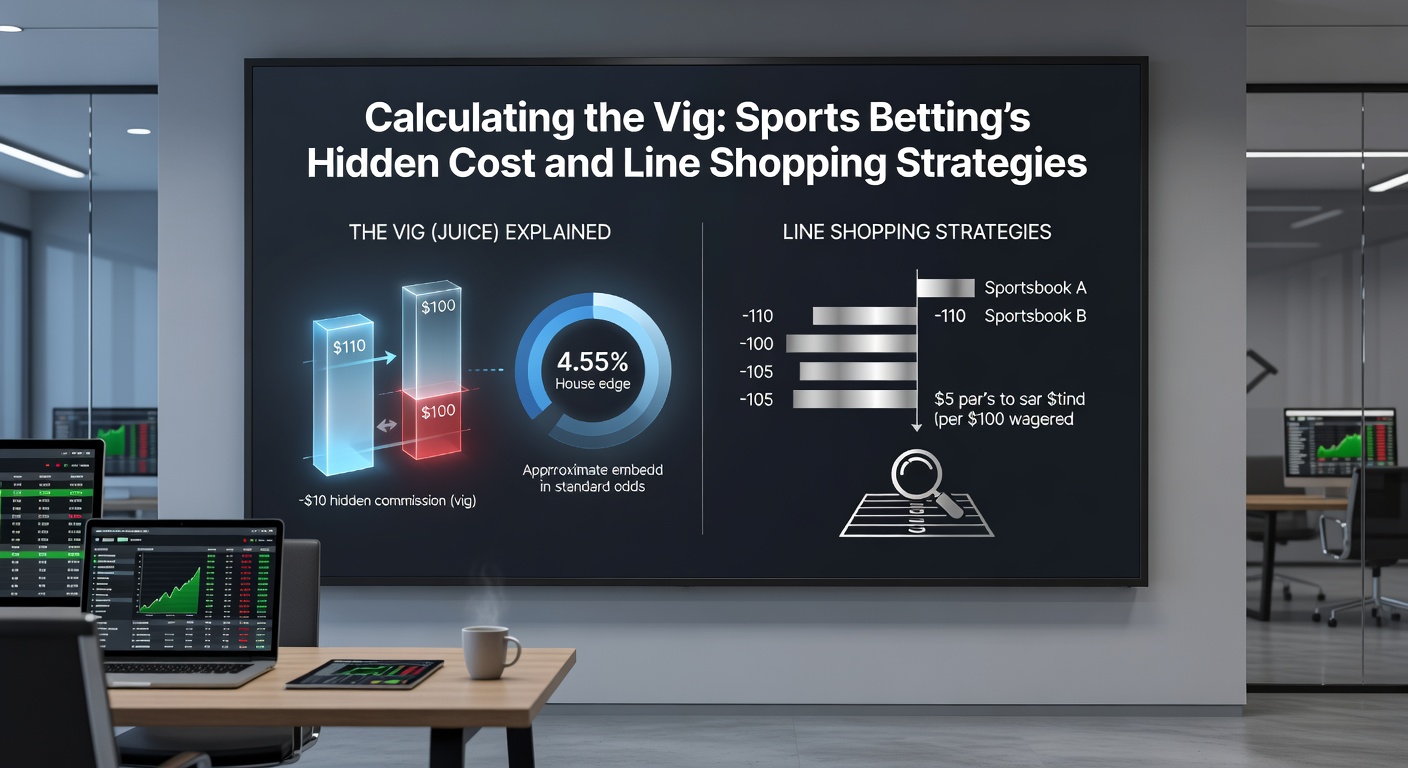
Now picture high-volume bettors in April 2026, with MLB opening day lines drawing $2 billion nationwide; vig at 4.5% on a $100 average bet drains $4.5 million collectively from even-money outcomes, underscoring why sustainability demands more than picks. Studies from Australia's Journal of Gambling Studies confirm that unadjusted betting yields negative expected value long-term, as houses leverage volume for steady revenue streams untouched by results.
Line Shopping: The Antidote to Vig's Grip
Bettors who compare odds across platforms slash effective vig dramatically, often dropping it below 2% by grabbing -105 instead of -115 on the same play; platforms like DraftKings, FanDuel, and BetMGM routinely diverge by 10-20 cents, especially on props where one book offers +EV while others lag. Observers tracking April 2026 action note how NBA futures saw 15-cent spreads between leaders, turning a standard $100 bet into $10 extra profit per unit through savvy hunting.
So how do sharp players execute? They maintain accounts at 5-10 books, refreshing lines pre-tipoff since soft books juice less to attract action; apps aggregate this data in real-time, flagging discrepancies like a -3.5 at -108 on one site versus -110 elsewhere. And it pays off: research indicates line shoppers boost ROI by 1-2% annually, enough to flip red ink black over hundreds of wagers.
Take one case from the 2025 playoffs where a bettor shopped UFC lines, landing +120 on an underdog listed +105 maximally elsewhere; that 15-cent edge, repeated across cards, yielded 12% returns while peers stuck at house standards. Yet pitfalls lurk—geo-restrictions in states like Wisconsin, fresh off tribal mobile launches, limit options, so VPNs or proxies stay off-limits under regs, forcing focus on legal apps.
Advanced Tactics and Tools for Edge Hunters
Beyond basics, pros calculate closing line value (CLV), measuring beats against final numbers to gauge skill; beating the close by 1% correlates to profitability, as vig-neutralized lines expose true edges. Software like Unabated or OddsJam scans hundreds of markets, alerting to +EV spots where implied probs undervalue outcomes, a method refined through backtesting on historical data.
But here's the thing: in April 2026, with prediction markets like Kalshi blending into sports via event contracts, vig dips under 2% on select plays, blurring lines between betting and trading while regulators watch closely. Bettors blending these—say, shopping Polymarket's peer-to-peer odds against traditional books—uncover arbitrage, locking risk-free gains when spreads exceed vig totals.
- Track personal CLV weekly to benchmark against peers averaging 0.5% beats.
- Prioritize player props, where vig averages 5-7% but shopping yields 20-cent swings.
- Use bankroll units scaled to variance, preserving capital as vig grinds.
Those applying these religiously report sustained edges, turning the house's weapon into their advantage through discipline and tech.
Conclusion: Mastering Vig for Long-Term Wins
Understanding vig calculations empowers bettors to confront sports betting's core math head-on, while line shopping transforms theoretical edges into tangible results; data underscores that ignoring either caps potential amid booming markets hitting $14 billion projections for 2026. Experts emphasize consistent application—scanning lines, chasing value, tracking metrics—as the path forward, especially with April's playoff surges amplifying opportunities and risks alike. In the end, those who decode and defy the vig don't just play; they compete on equal footing with the houses shaping the odds.